

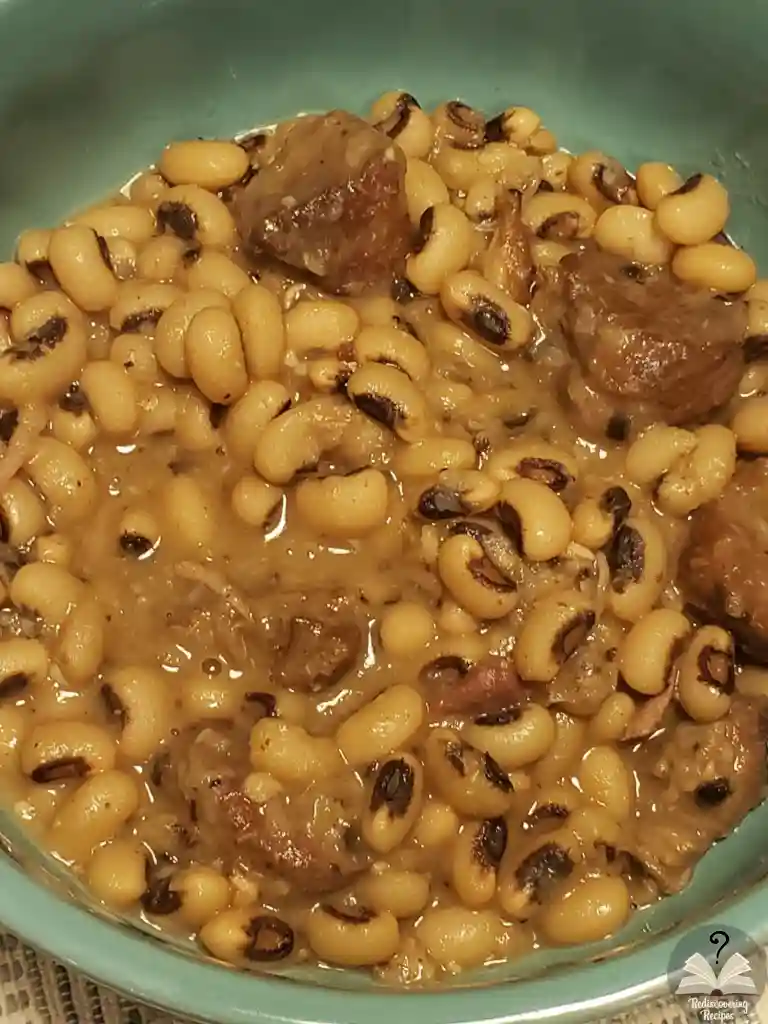
Jacques Pépin once said on Essential Pépin (his famous cooking show) that dried black eyed peas can't absorb more water after two hours of soak time (I'm paraphrasing of course). Yes, I know the internet tries to convince you to soak all day and even overnight, but I put it to the test. I found that an overnight soak made the cowpeas way too mushy for the cooking time, whereas a one-hour soak needed another 30 minutes of simmering time. Soaking anything overnight runs the risk of mold and fermentation, and you definitely don't want that.
My gramma never did the overnight soak. In fact, when she would make these, she started the soak after lunch to be ready for supper. I found the two-hour pre-soak is just long enough to come out as "tender-crisp" with that satisfying texture that is not mushy or not too hard, similar to al-dente pasta.
If you haven't heard of salt pork, well, it's a pretty common ingredient in the South. It looks just like bacon but acts different in that it adds a deep umami and a needed saltiness to this dish. You should adjust the amount of salt pork to your family's palate instead of seasoning the pot with actual salt, since a little bit of salt pork goes a long way, and just add any salt in the end to get it seasoned just right before serving.
If you look at other common recipes (even big-name chefs), they try to convince you to use bacon, but those are just bloggers that have never actually made a dish like this, much less even know what it's supposed to taste like. Besides, bacon is so expensive these days that I hope you didn't just watch a random internet video, grab your breakfast, and throw it in the pot instead of salt pork. Part of the cooking method is to remove it at the end once it's been rendered anyway, and who would ever eat boiled soggy flavorless bacon?
Growing up, we would mostly eat this dish in the fall and wintertime, especially around the Holidays, and my grandma would add chunks of cured ham to the pot when she had some. I don't really buy ham butts because it's just so much to eat, but if you can find a cut of smoked or cured meat, by all means add it to the pot. You can really add anything to a pot of beans and have a stellar dish; just make sure you pick the meat first then add it back to the pot.
Cured Ham Chunks - This is what my family likes. You can cube it up however you like, but because its already cured, add it towards the end so it holds its texture.
Smoked Ham Hocks - This is a common addition, but you might need to parboil these a little bit first to be tender enough for the finished dish. Pick off the meat, add it back to the pot.
Smoked Turkey - A healthier and leaner option, commonly found at the market as legs or wings. These are already cooked, so add them in towards the end. Pick off the meat and add it back to the pot before serving. Save the bones and skin for poultry stock.
Grab your favorite pot and make this dish for people you love!
Enjoy this timeless dish that starts with a pre-soak for the black-eyed peas before they mingle in a slow stovetop simmer. This is perfect as a Holiday dish, along with warm cornbread, to invite good luck into your home. It also shines for those Sunday dinners that will bring everyone together with its warm, satisfying flavors.
In a Dutch Oven or stock pot over medium-high heat, arrange the salt pork in a single layer to render while you finish prepping. Don’t forget to flip to render both sides.
At the cutting board:
Add the water and bay leaves to the pot, give a good stir, then turn the heat up high to boil.
At the soaking bowl, discard any beans that are floating and remove any ghost skins you see. Pick up the colander, rinse thoroughly with clean water, and add directly to the pot. Give another good stir.
Once the pot is boiling, cover, and lower the heat to a slow simmer for 60 minutes, stirring again after 30 minutes.
Remove the lid and set aside. Give a good stir, and simmer uncovered for 30 more minutes or until the desired texture is achieved.
Turn off the heat, then pick out the bay leaves and boiled pieces of salt pork and discard. Adjust the final seasoning with salt, using more or less.
For a creamier consistency, using a potato masher or the back of the ladle, mash some of the peas directly in the pot. Mash as much or as little as you wish to make it creamy.
This dish pairs really well with our Southern Skillet Cornbread recipe.
References: River Road Recipes (The Junior League of Baton Rouge)
Thank you for visiting RediscoveringRecipes.com and exploring our recipes! We're delighted you found one worth printing and keeping.
Please come back soon to rate and review it. We'd love to see your feedback!